


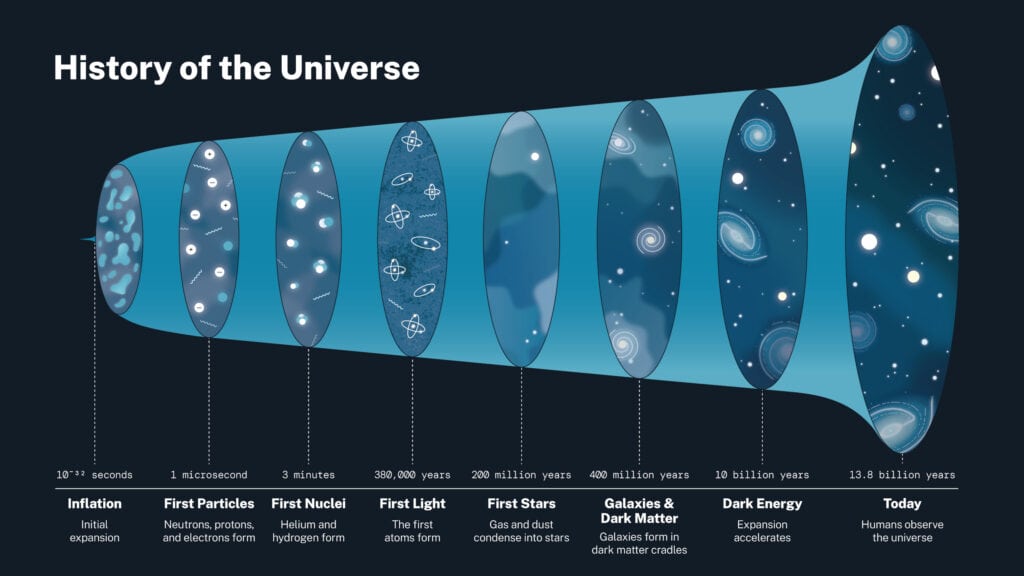
Although it’s rare in Earth’s atmosphere, hydrogen is the most abundant element in the universe. This single element makes up about 75% of all existing matter. Most of this hydrogen was created in the first few minutes after the Big Bang event, approximately 13.8 billion years ago.1Wikimedia Foundation. (2026, March 6). Big Bang nucleosynthesis. Wikipedia. https://en.wikipedia.org/wiki/Big_Bang_nucleosynthesis.2Wikimedia Foundation. (2026, March 2). Big Bang. Wikipedia. https://en.wikipedia.org/wiki/Big_Bang.
On Earth, hydrogen is usually found combined with other elements, for example, in water (H₂O) or in fossil fuels like methane (CH₄). Hydrogen almost never exists as pure H₂ unless humans make it or the gas escapes from rocks and soils.4U.S. Energy Information Administration. (n.d.). Hydrogen. Hydrogen (Energy Kids page).
Hydrogen on Earth
Earth’s Atmosphere
Just how rare is hydrogen on Earth? By volume, hydrogen make up just .5 to 1.0 ppm (parts per million) of the Earth’s atmosphere. Why? Hydrogen is so light, that it escapes Earth’s gravity.5American Chemical Society. (2020, June 22). Hydrogen. https://www.acs.org/molecule-of-the-week/archive/h/hydrogen.html
Earth’s Crust
Hydrogen makes up about .75% of Earth’s crust by weight. On Earth, hydrogen is usually found combined with other elements, for example, in water (H₂O) or in fossil fuels like methane (CH₄). Hydrogen almost never exists as pure H₂ unless humans make it or the gas escapes from rocks and soils.6U.S. Energy Information Administration. (n.d.). Hydrogen. Hydrogen (Energy Kids page).7American Chemical Society. (2020, June 22). Hydrogen. https://www.acs.org/molecule-of-the-week/archive/h/hydrogen.html Hydrogen’s ability to combine with other elements matters because it enables hydrogen to help store energy that we can release later. As we’ll see, that makes it an exciting prospect for clean energy.