


Earth’s history is divided into four eras: Precambrian, Paleozoic, Mesozoic and Cenozoic. We now know that the Precambrian Era comprises most of Earth history, around 78%, lasting from 4.54 billion years ago to around 540 million years ago. The lengths of time the other eras represent can be seen on a time scale. Where do these numbers come from? These numbers refer to absolute time, the other way geologists refer to geologic time.

What is Absolute Time?
Absolute time means the exact number of years before today that something happened. For example, scientists might say an event occurred 65 million years ago.
Geologists use absolute dating to figure out the age of rocks and events. This is similar to how you can check someone’s birth certificate or driver’s license to know their exact age. In geology, scientists determine these ages by studying isotopes (types of elements) inside minerals in rocks using laboratory tests.
Long ago, scientists didn’t have the tools to measure exact ages, so early versions of the geologic time scale didn’t include specific numbers of years. Over time, as technology improved, scientists were able to assign exact ages to different time periods and events. For example, scientists know that the Cretaceous Period ended about 65 million years ago because they found and dated a layer of volcanic ash that appears all around the world.
To figure out how old a rock is, scientists use a method called radiometric dating. This involves studying tiny particles inside the rock called radioactive isotopes. These isotopes are unstable, which means they change over time.
As they change, they go through a process called radioactive decay, where the atom breaks apart and releases small particles. The original unstable atom is called the parent isotope. As it loses particles, it transforms into a new, more stable atom called the daughter isotope.
Scientists know how fast this change happens. They use a measurement called a half-life, which is the amount of time it takes for half of the parent isotopes to turn into daughter isotopes. After one half-life, half of the original atoms are gone. After another half-life, half of what’s left changes again, and so on.
By comparing how much of the parent isotope is still in a rock to how much daughter isotope has formed, scientists can calculate the rock’s absolute age, or its exact age in years.
The image below illustrates radioactive decay. You can see with each half-life, the parent isotope decreases by half.
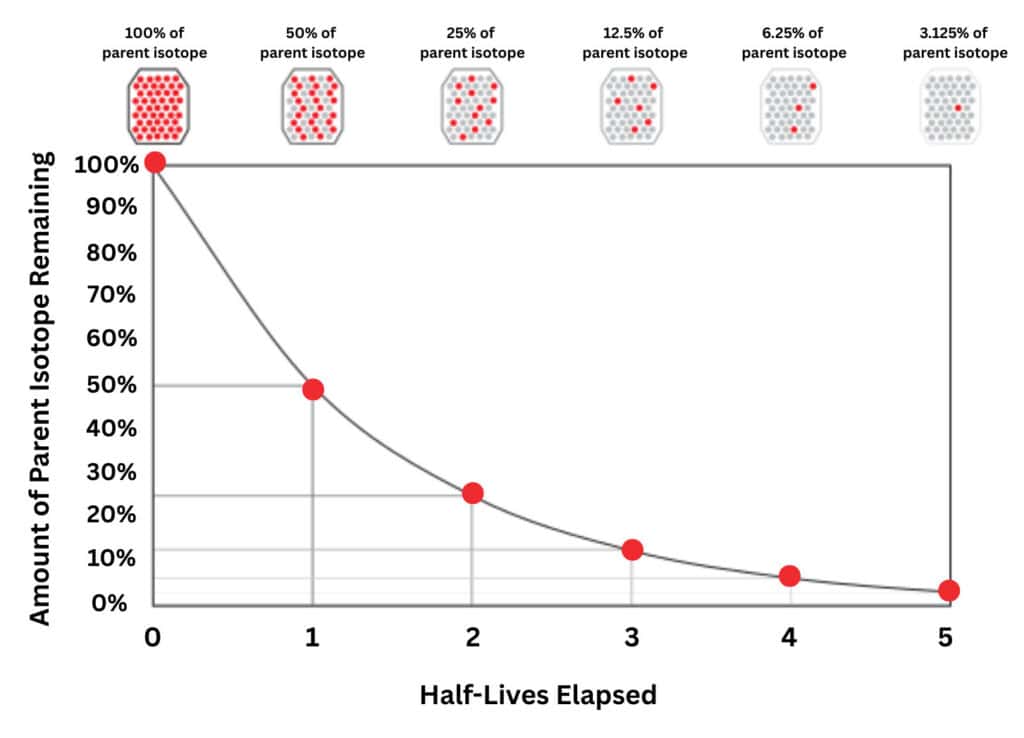
How do scientists find out a more precise age of a rock or fossil sample? They analyze the sample using specialized equipment to determine the % of parent isotope remaining in the sample. The remaining % of the parent isotope is used to calculate the age of the sample.
The example below shows the steps taken to calculate the absolute age of a rock or fossil sample.
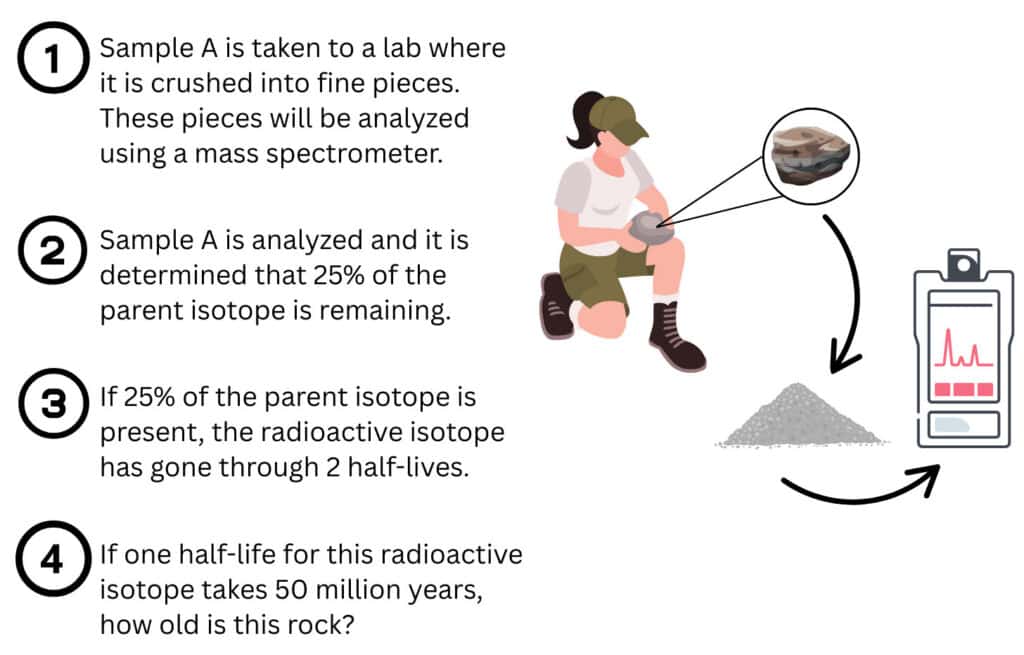
Image Credits
- Geologic-Time-Scale-Infographic: AI
- Half-Life-Diagram: https://commons.wikimedia.org/wiki/File:Radiometric_Dating.svg
- Absolute-Dating-Example (Sab): Sabrina Ewald