


Geologic Time and the Rock Record
Now that you understand both relative dating (comparing which rocks are older or younger) and absolute dating (determining exact ages), you can see how scientists put Earth’s history together.
Geologic time is incredibly long, so scientists divide it into smaller sections to make it easier to study. Early geologists used relative dating principles, like superposition, to place rock layers in order from oldest to youngest. They also named these layers and time intervals based on where they were discovered.
Later, with the development of absolute dating techniques, scientists were able to assign specific ages (in years) to these rock layers. By combining both methods, scientists created the geologic time scale, which organizes Earth’s history into named intervals (like eras and periods) along with their actual ages.
Even with these tools, the rock record isn’t perfect. In many places, there are gaps called unconformities, where layers are missing. For example, if a 10,000-year-old rock layer sits directly on top of a 40,000-year-old layer, that tells us that 30,000 years of history are missing from that location. Using your knowledge of relative and absolute dating, you can recognize both the order of events and the size of the missing time gap. Because no single location has a complete record of Earth’s history, scientists compare rock layers from many different places around the world. By combining relative dating (to match layers) and absolute dating (to assign ages), they build a more complete and accurate geologic time scale.
Locating Oil and Natural Gas in the Subsurface
This knowledge is important for finding oil and natural gas subsurface (underground). Over millions of years, certain environments on Earth produced large amounts of organic material (from once-living things) that eventually turned into fossil fuels. These materials became trapped in layers of rock beneath the surface. That’s why scientists need to understand the ages of rock layers—both how old they are compared to each other (relative age) and their exact age (absolute age).
One important time period is the Mesozoic Era (about 252 million to 66 million years ago). During this time, Earth had a warm climate, and the oceans were full of life. However, the oceans had very little oxygen, which slowed down the process of decomposition (the breaking down of dead organisms).
Because of this, when marine organisms died, their remains piled up on the ocean floor faster than they could decompose. Over time, thick layers of organic material formed. There was much more of this material than in many earlier periods of Earth’s history. As these layers were buried deeper and deeper under sediment, they were exposed to heat and pressure for millions of years. This process eventually transformed the organic material into oil and natural gas.
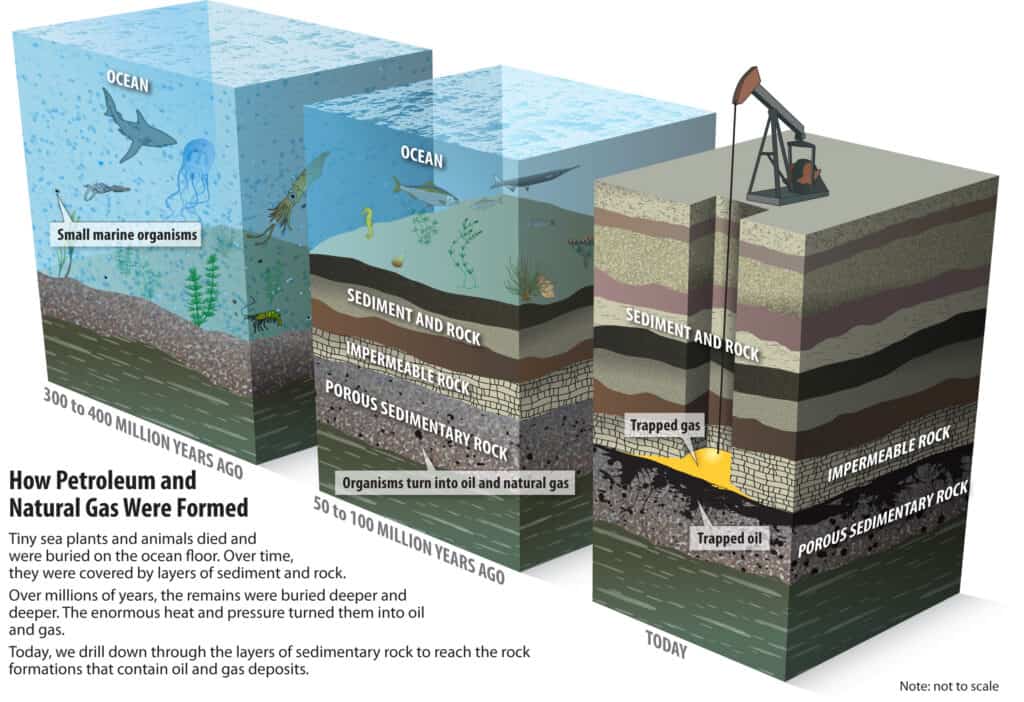
By studying rock outcrops and subsurface core samples, scientists and engineers gather critical information that helps them identify potential hydrocarbon resources. Advances in scientific understanding and technology have made it possible to safely and efficiently produce these resources from deep within the Earth. Successful exploration requires an integrated approach that combines insights from both surface observations and subsurface data. In essence, we use clues preserved in the geologic record to locate the valuable energy resources that power our society today and will continue to support our needs in the future.
Image Credits
- oilNaturalGasFormation: NEED Project