


Metamorphic rocks are unique in that they form exclusively beneath Earth’s surface. They develop when existing rocks are subjected to intense heat and pressure, which causes both physical and chemical changes in their mineral composition. These conditions are commonly found at convergent plate boundaries, where tectonic forces generate significant pressure, or in areas where molten magma comes into contact with surrounding rock, raising temperatures enough to trigger metamorphism.
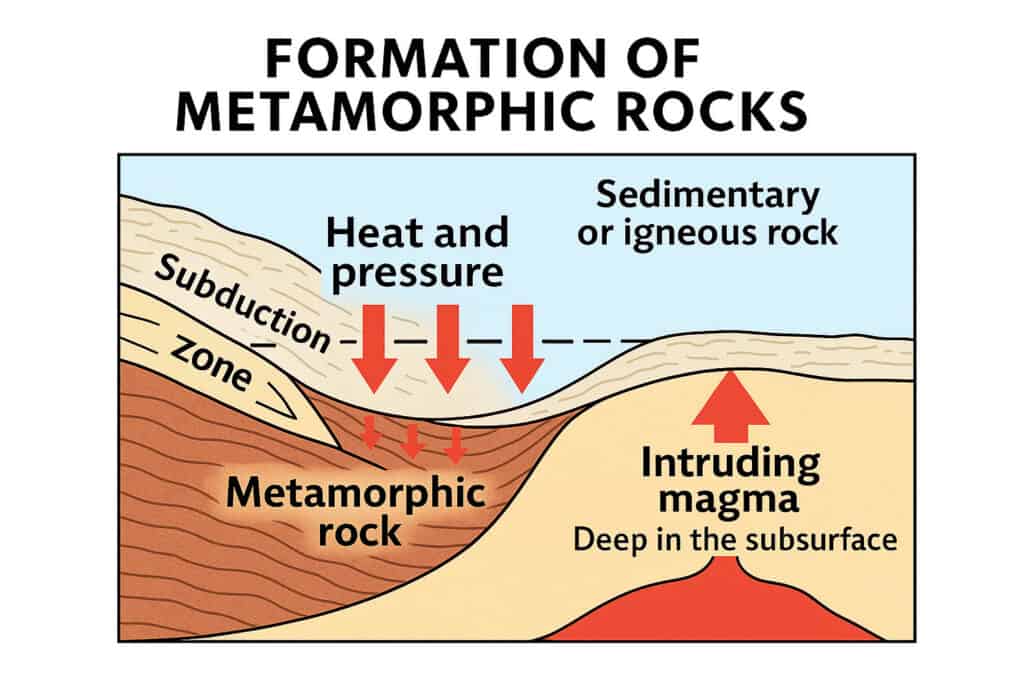
Types of Metamorphic Rocks
Metamorphic rocks are divided into two main types: foliated and non-foliated. Foliated metamorphic rocks have a clear layered or banded appearance. This forms when the original rock (called the parent rock) contains flat, plate-like minerals. Under intense heat and pressure deep within the Earth, these minerals are squeezed and rearranged so that they line up in parallel layers. This alignment gives foliated rocks their distinct striped or layered look. A common example is slate, where strong pressure flattens the minerals into thin, visible layers.
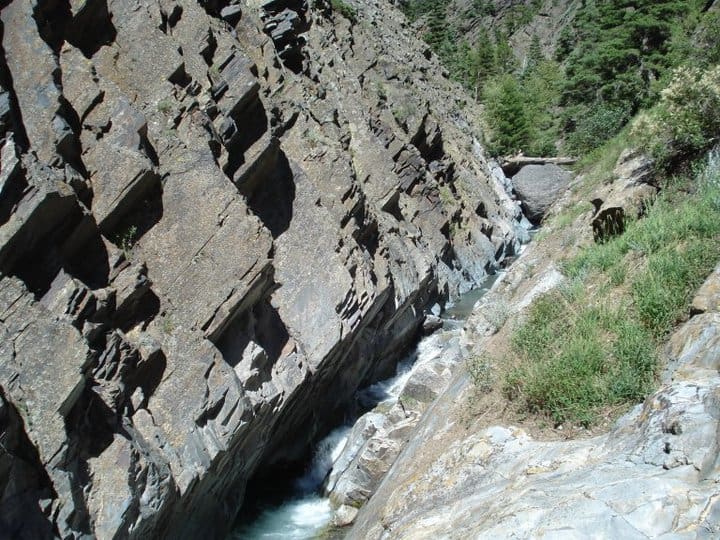
Non-foliated metamorphic rocks, on the other hand, do not have a layered appearance. Their minerals do not line up in sheets because they are usually made of minerals that are not flat or are arranged randomly. Instead of forming layers, these rocks tend to look more solid and uniform throughout. Non-foliated rocks often form when heat is the main factor in changing the rock, rather than pressure that pushes minerals into alignment. Examples include marble and quartzite, which have a smooth, even texture without visible layers.
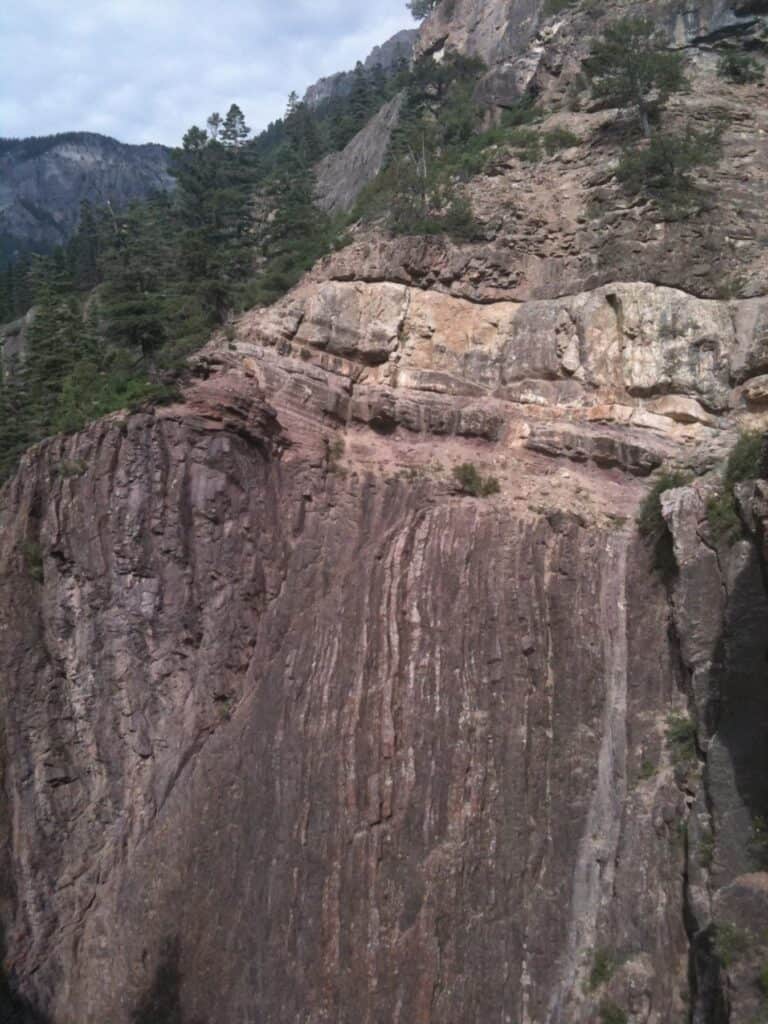
The bottom of the formation is Uncompahgre quartzite, approximately 1.3 billion years old.
Metamorphic Rock Resources
Like igneous rocks, hydrocarbons—such as oil, natural gas, and coal—do not form within metamorphic rocks. The intense heat and pressure involved in metamorphism chemically transform any preexisting organic material that may have been present in the pore spaces of the original rock, preventing the preservation or formation of these fuels.
Metamorphic rocks are primarily valued as dimension stones used in construction and design. They are commonly utilized in building façades, flooring, and countertops, as well as in decorative and artistic applications such as statues and jewelry.
Some common uses of metamorphic rocks include:
Building and Construction Materials
•Marble – building stone, flooring
•Slate – tiles and structural elements
•Quartzite – high-strength construction stone
Countertops and Interior Design
•Marble – countertops and vanities
•Quartzite – durable countertops
•Soapstone (talc-rich rock) – countertops and sinks
Monuments and Sculptures
•Marble – statues, monuments
•Slate – gravestones and markers
Roofing and Paving Materials
•Slate – roofing shingles
•Quartzite – paving stones and walkways
Decorative Stone and Landscaping
•Gneiss – landscaping stone and walls
•Schist – decorative rock features
•Marble – garden features and decorative stone
Jewelry and Ornamental Uses
•Garnet (in schist/gneiss) – gemstones
•Jade (metamorphic origin) – jewelry and carvings
•Marble – ornamental carvings
Industrial Applications
•Graphite (from metamorphosed carbon) – pencils, lubricants, batteries
•Talc (from metamorphosed ultramafic rocks) – cosmetics, paper, ceramics
Image Credits
- Formation-of-Metamorphic-Rocks: AI
- slate-in-Colorado: Photo Credit: Sabrina Ewald
- Box-Canyon-CO (unconformity): Photo Credit: Sabrina Ewald