


There are six foundational principles of relative dating that help geologists establish the sequence and relative age of rock formations or outcrops.
The first four of the relative dating principles were developed by the Danish scientist Nicolas Steno (1638-1686) after settling in Italy: Original Horizontality, Lateral Continuity, Superposition, and Cross-Cutting Relationships.
Principle of Original Horizontality
The Principle of Original Horizontality requires that a sequence of layered sedimentary rocks must be deposited horizontally. If you were to pour a bucket of sand into a bathtub, the sand would form a horizontal layer. The same applies for sediments in an ocean. They will be deposited horizontally. One of the applications of this principle is that, if one observes layers that are not horizontal, events or processes have occurred that have caused the layers to be tilted, folded, etc.

Principle of Lateral Continuity
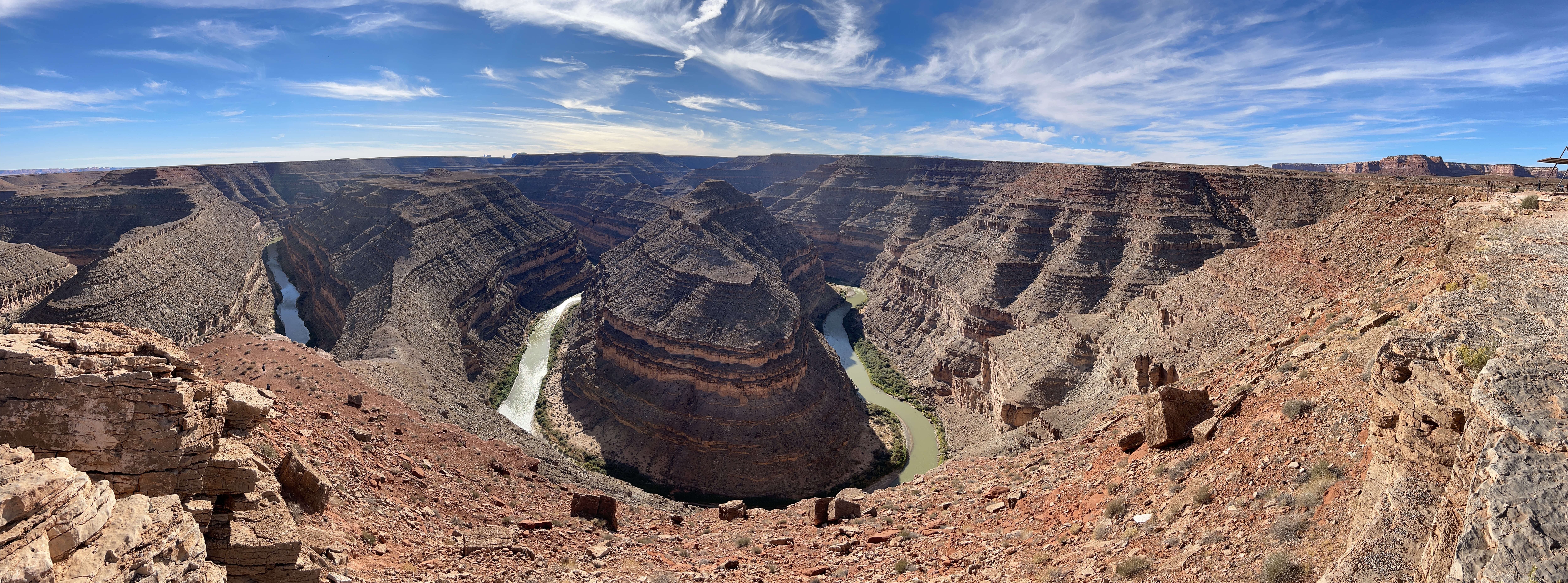
The Principle of Lateral Continuity states that a sedimentary layer is laterally continuous and is the same age throughout. This principle is useful when layers are followed across some distance. Thus, any information about the relative ages of layers determined at one locality may be transferred to another locality.
Lateral Continuity can be seen at Goosenecks State Park in Utah. As the river cut through the sedimentary rock layers, those layers are no longer connected. Yet we know that these layers were once continuous, thus the rocks are the same age.
Principle of Superposition
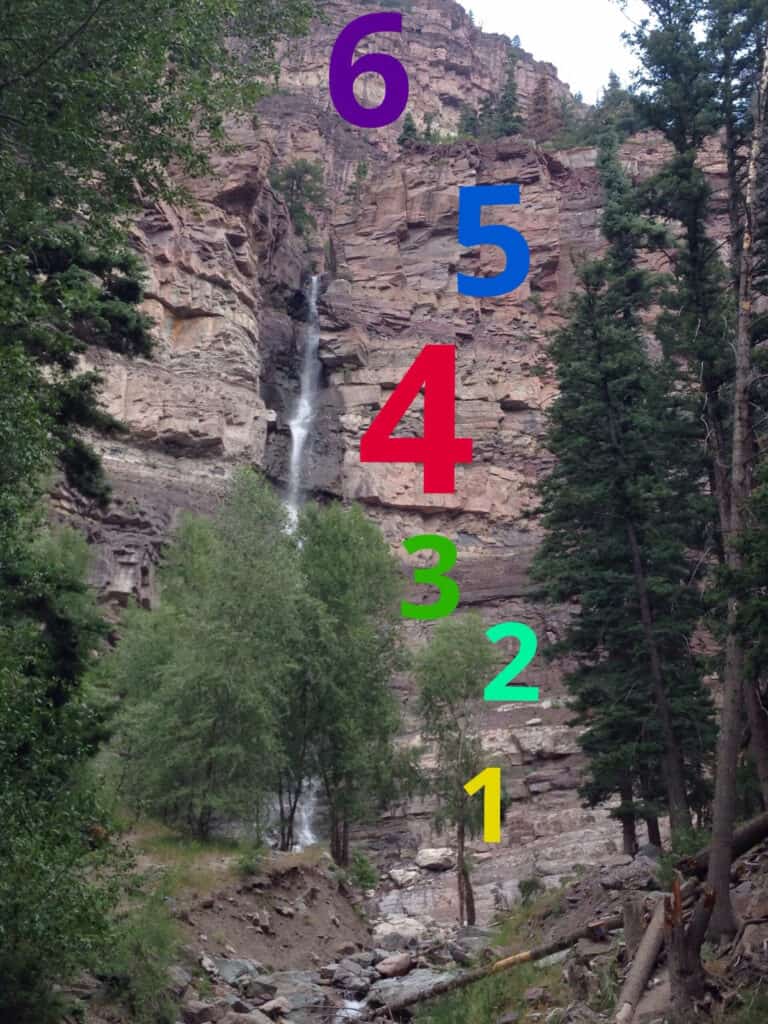
The Principle of Superposition states that in a sequence of sedimentary layers, those layers at the bottom are older than those layers at the top. This should make sense if you consider the layering of rocks like layers of a cake. It would be very difficult (impossible) to place the uppermost layer of the cake on without the lower layers already being there. The bottom layer must be placed first, before the other layers can be placed on top. Returning to a sequence of layered rocks, the same logic applies. Suppose you are looking at a cliff with different layers. The simplest interpretation is that the layer at the bottom is the oldest (was deposited long ago) and the layer at the top is the youngest (was deposited more recently). This will be true provided the entire sequence has not be turned upside down in a tectonic event. One way to determine if such an event has occurred is by looking at the details in the layers to determine if they are “right side up” or not.
Superposition can be clearly seen at Cascade Falls in Ouray, CO. The sedimentary rock layers display a sequence of time from oldest to youngest.
Principle of Cross-Cutting Relationships
The Principle of Cross-cutting Relationships states that any rock or feature that cuts through another layer is younger than the layer it cuts through. An analogy often helps: in order for a knife to cut through a cake, the cake must be in place before the cutting. The cutting event itself is therefore younger than (has occurred more recently than) the cake it is cutting through. In geology, this principle is involved mostly when layers are truncated by a fault, dike, or erosion surface. An igneous intrusion that cuts across a layer can be said to be younger than the layer it cuts. The age of any fault affecting a sequence of rocks is necessarily younger than the age of formation of those rocks.
The Painted Wall in Black Canyon, CO is a perfect example of a cross-cutting relationship. The white veins throughout the cliff wall are pegmatite intrusions (magma that cooled slowly over time to form an igneous rock). These pegmatite veins cut through the existing metamorphic rock, creating this stunning structure. Black Canyon is primarily composed of the metamorphic rock gneiss and it is approximately 1.7 billion years old. The pegmatite intrusions are younger than the gneiss.

The fifth principle was developed by a geologist from Scotland, James Hutton (1726-1797).
Principle of Inclusions
The Principle of Inclusions states that any rock fragments that are included in a rock must be older than the rock in which they are included. For example, a fragment of granite must be older than the sedimentary rock that includes it: the granite fragment was derived from a granite that is older than the sedimentary rock.

The sixth principle was developed by a British surveying engineer, William Smith (1769-1839).
Principle of Faunal Succession
The Principle of Faunal Succession states that fossils of different species appear and disappear in a specific order in sedimentary rock strata. This order is reliable and can be identified over long distances. Thus, the layers of sedimentary rocks in any given location contain fossils in a definite sequence; the same sequence can be found in rocks elsewhere, and strata can be correlated between locations.

The subtle changes of certain fossils through time were one of the initial arguments for evolution. The relative order of fossil events allows the geologist to describe the history of the earth within the context of time. Although Charles Darwin would not propose the theory of evolution by natural selection until after Smith’s death, Smith’s work enabled future geologists and biologists to think in terms of long expanses of time—a necessary ingredient for Darwinian evolution.
Practice applying these relative dating principles by answering a series of questions in the next section of this lesson.
Image Credits
- Palo-Duro-Canyon: Sabrina Ewald
- Goose-Necks: Sabrina Ewald
- Superposition-Ouray-Colorado: Sabrina Ewald
- Painted-Wall-Black-Canyon: Sabrina Ewald
- Inclusions: Sabrina Ewald
- Faunal-Succession: https://commons.wikimedia.org/wiki/File:Fossils.png