


Fossils play a crucial role in locating oil and natural gas within the subsurface. Because we understand the environments where these resources originally formed, we can use knowledge of rock formations and fossil evidence to identify those ancient settings. Fossils can indicate the presence of oil because they provide clues about the ancient environments where hydrocarbons formed. Here’s how:
- Source Material: Oil and natural gas come from the remains of microscopic plants and animals (like plankton) that lived in oceans or lakes millions of years ago. Fossils of these organisms suggest that organic material was abundant in that area.
- Depositional Environment: Certain fossils indicate environments like shallow seas or swamps, which are ideal for accumulating organic matter. These environments often lead to the formation of source rocks (like shale) that generate hydrocarbons.
- Age and Rock Layers: Fossils help geologists determine the age of rock layers. Knowing the age helps identify periods when conditions were right for hydrocarbon formation.
- Correlation: Fossils allow geologists to correlate rock layers across regions, helping predict where oil-bearing formations might extend underground.
In short, fossils act as environmental markers—if you find the right types of fossils in the right rocks, it suggests the conditions for oil formation were present.
Case Study: Permian Basin
A great real-world example of this process is the Permian Basin in West Texas and southeastern New Mexico, one of the most productive oil regions in the world.
- Ancient Environment: Around 250–300 million years ago, this area was covered by shallow seas, rich in marine life like plankton and algae.
- Fossils as Clues: Geologists find marine fossils (such as ammonites and brachiopods) in the rock layers, indicating that organic material was abundant.
- Source Rocks: These organisms were buried in sediment and transformed into organic-rich shale, the primary source rock for hydrocarbons.
- Oil Reservoirs: Over millions of years, heat and pressure converted the organic matter into oil and gas, which migrated into porous limestone and sandstone reservoirs.
- Modern Exploration: Today, fossil evidence and rock analysis help geologists map these layers and locate drilling sites.
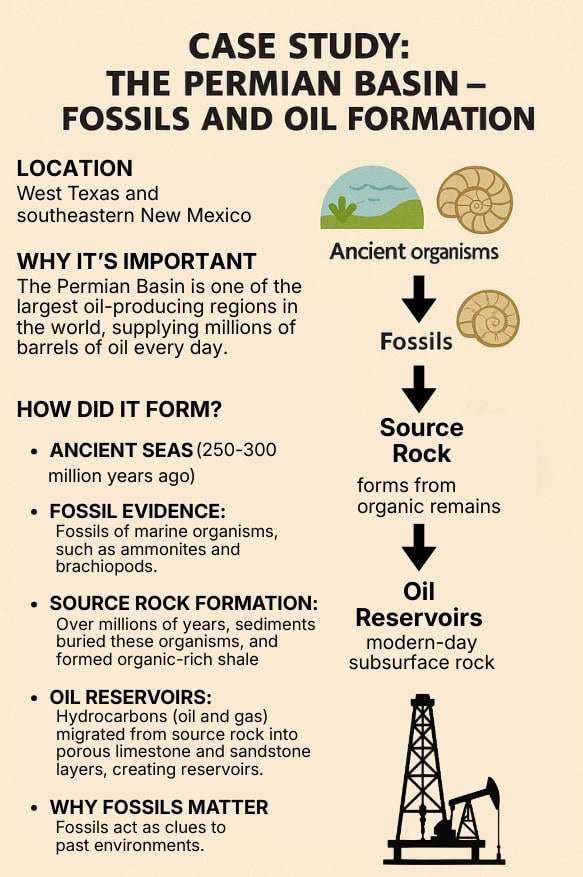
Image Credits
- Case-Study-The-Permian-Basin: Sabrina Ewald