


Now that you understand how absolute dating works, you will practice applying your knowledge by completing the following activities.
Before practicing your skills, here is an example to help prepare:
Example Activity
Imagine you have a jar filled with 100 glowing marbles. These marbles don’t glow forever—each one will eventually stop glowing. But here’s the special part:
- The marbles fade in a predictable way.
- Every hour, half of the glowing marbles stop glowing.
- That “hour” is the half‑life.
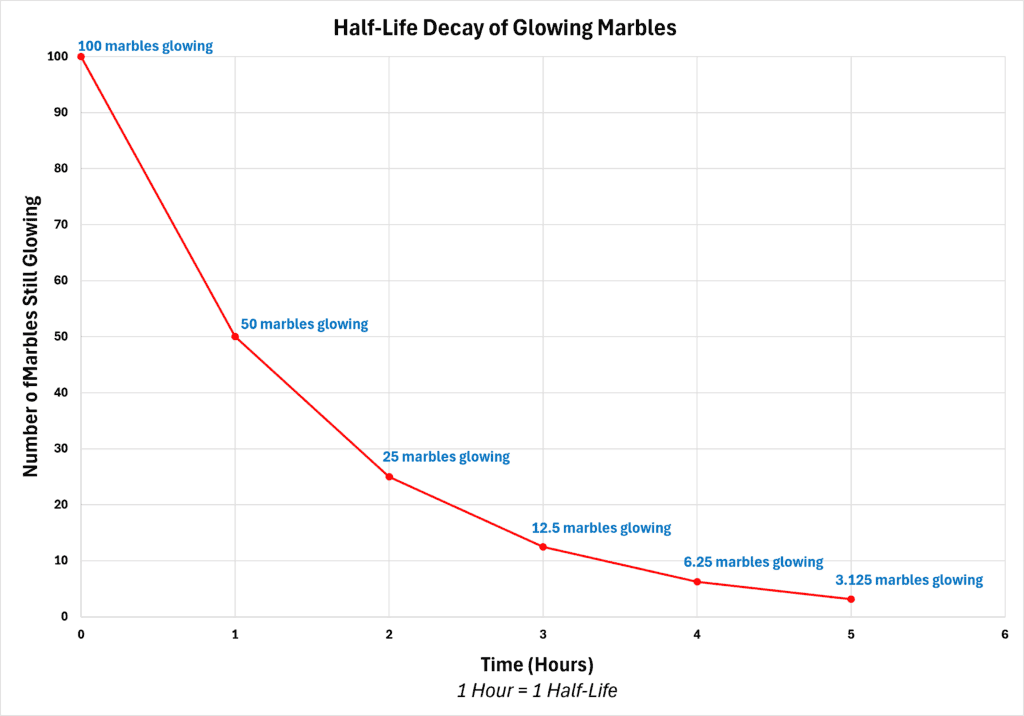
At the start (0 hours) all 100 marbles are glowing.
After 1 half-life (1 hour): Half of them stop glowing.
✨ 50 marbles are still glowing.
After 2 half-lives (2 hours): Half of the remaining 50 marbles fade.
✨ 25 marbles still glowing.
After 3 half-lives (3 hours): Half of the 25 remaining marbles fade.
✨ 12.5 marbles still glowing.
The marbles don’t all go dark at once—just like atoms don’t all decay at once.
Each half-life cuts the amount in half, no matter how many are left.
Practice Calculating Absolute Age
Now it’s your turn to put your knowledge of half-lives and radioactive isotopes into action. Work through the practice problems in the interactive presentation below. Read each question carefully and use what you’ve learned to calculate absolute age using half-lives and radioactive decay.
You can click on the arrows at the bottom right to enlarge the slide.