


Relative Time
Rocks are like a history book for Earth—they record what has happened over millions of years. Geologists (scientists who study Earth) talk about time in two main ways: relative time and absolute time.
- Relative time tells us whether one rock or event is older or younger than another, without giving an exact age.
- Absolute time gives a specific age, usually in years (like 100 million years old).
Geologists study layers of rock, called strata, in something known as a stratigraphic sequence. They use rules, or principles, to figure out the order of these layers. One important rule is the Principle of Superposition, which says – In a stack of rock layers, the oldest layer is at the bottom, and the youngest layer is at the top. Think of it like stacking books or making a layered cake—the first layer you put down ends up at the bottom.
This method is similar to how people can guess relative age in everyday life (for example, noticing that a person with gray hair is usually older than someone without it).
Not All Rocks Look the Same
Even if rocks formed at the same time, they may look different depending on where they formed. Because of this, geologists give local names to specific rock layers. These named rock units are called formations:
- A formation is a group of rocks that can be tracked across a large area.
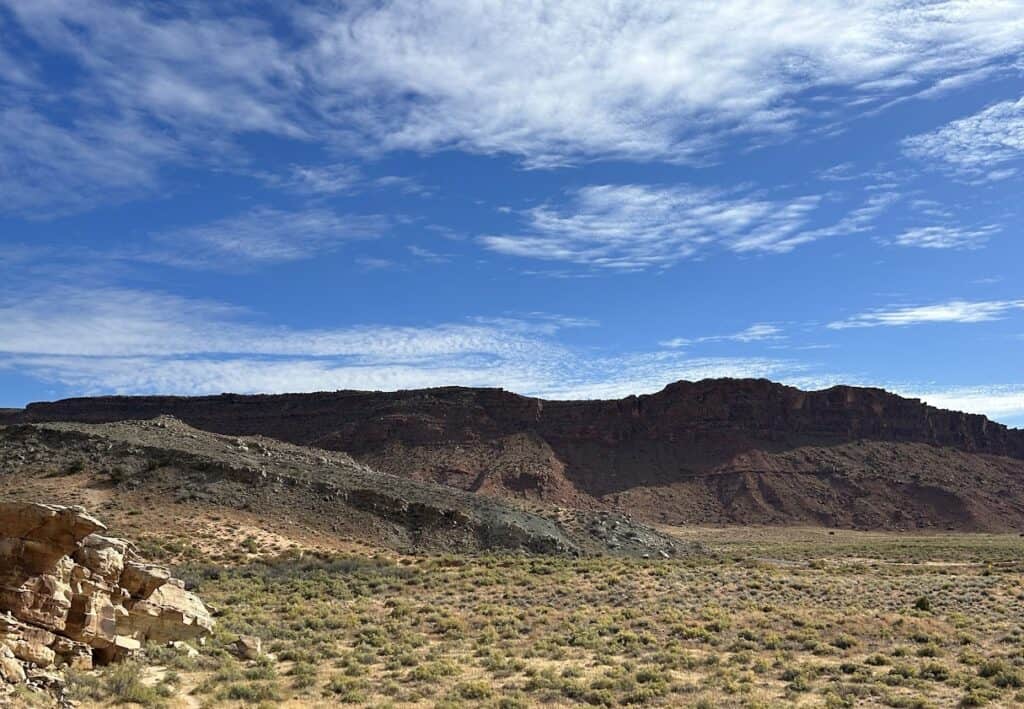
- Example: The Morrison Formation in Utah includes rocks formed during the Jurassic Period.
So when scientists mention the Morrison Formation, they’re talking about a specific set of rock layers from a certain time and place.
Stratigraphy
Stratigraphy is the study of the layers of rock that make up the Earth’s crust. Scientists look at these layers (strata) to understand how they are arranged, where they are found, and what they tell us about Earth’s past.
Each rock layer has its own features, such as its color, type, or the fossils inside it. By studying these features, geologists can:
- Map where different rock layers are located
- Figure out how the layers are related to each other
- Determine the order in which the layers formed over time
- Reconstruct Earth’s history, like past environments and events
Stratigraphy as a science was developed by William Smith, an English scientist in the late 1700s and early 1800s. He is often called the Father of English Geology. Smith made the first geological map of England and discovered that rock layers appear in a consistent order. This helped scientists understand that layers can be used to tell time in Earth’s history.
In simple terms, stratigraphy is like reading the pages of a history book—but instead of paper pages, it uses layers of rock to tell the story of our planet.
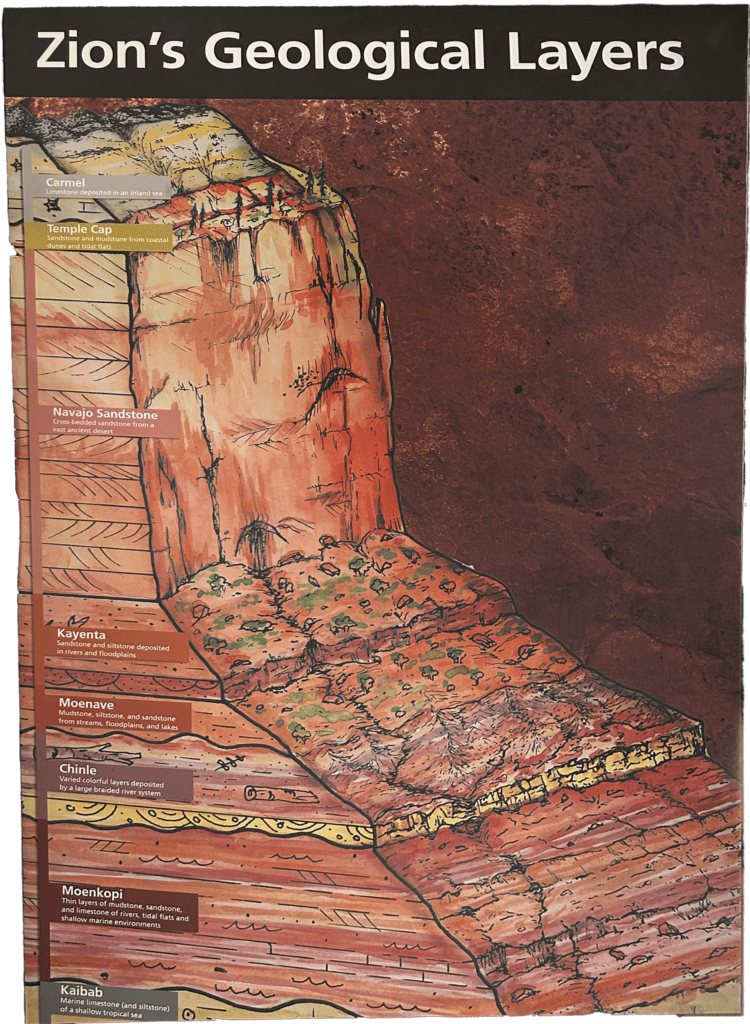
The image below shows the stratigraphy of Zion National Park in Utah. You can see the distinct sedimentary rock layers that are visible throughout the park.
Stratigraphic Analysis
How can scientists figure out the relative ages of different rock layers? In other words, how do we know that one layer of rock (Rock A) is older than another (Rock B)? As geologists spent more time looking at sequences of rocks outdoors, a number of principles were established.These principles help scientists determine the order in which rocks were formed, even if they don’t know the exact age in years. Learn more about these principles on the next page.
Image Credits
- Morrison-Formation-Arches-National-Park: Sabrina Ewald
- Zion Stratigraphic Column: Sabrina Ewald